
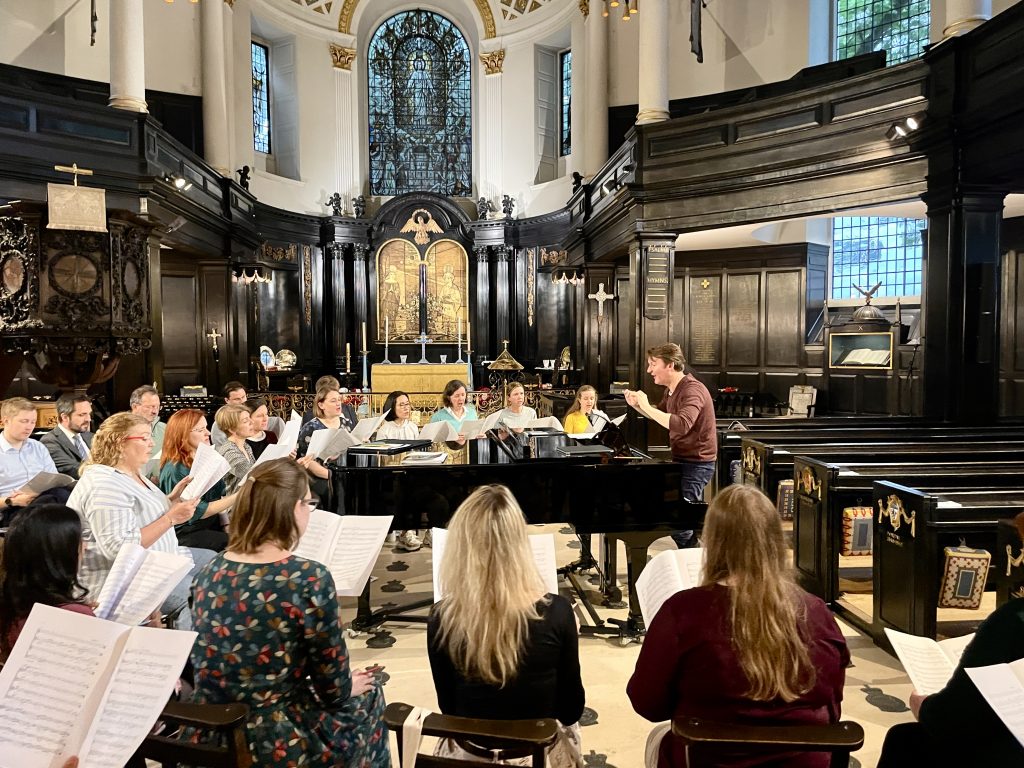
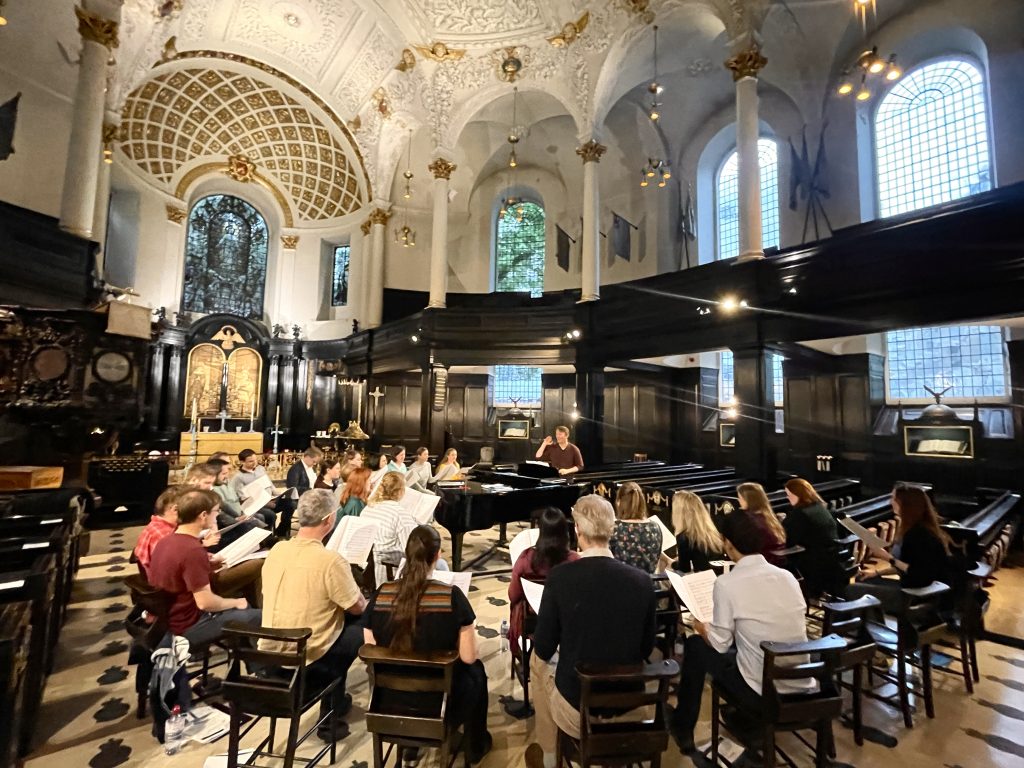
This Friday 20th June, London chamber choir Vivamus are singing Stephen Dodgson’s Canticle of the Sun (also recently recorded by Sonoro) at St James’s Piccadilly in their programme ‘This Shining Night’, which celebrates light in all its forms. I attended their rehearsal last week and spoke to their conductor and several of the choir about the piece and how it has connected with them, as they’ve been getting to know it.
Overview
Canticle of the Sun is a four-part ‘free, robust and imaginative’ setting of the poem of the same name by John Heath-Stubbs – reproduced below. There are calmly ethereal, prayerful (and almost comforting) Latin benedicite ‘refrains’ which act as a moment to breathe and reflect on what’s gone before, amid highly contrasting sections setting the English poem – sometimes sprightly, sometimes angular, sometimes rich and full. As alto Betsy Waalen put it, ‘There are almost multiple pieces going on interspersed with each other so that the benedicite sections and the poem sections are an interesting foil for each other.’ Conductor Rufus Frowde added that a great strength of the piece is that there’s ‘so much variety in the space of a 10-minute piece and yet it feels integral and complete’. Alto Carolyn Moores summed it up simply: ‘It’s mystical but joyous as well.’
Singers commented that listeners can enjoy the unusual, vibrant and evocative text of the poem, which opens ‘I am the great Sun. This hour begins my dancing day – pirouetting in a whirl of white light in a wide orchestral sky, a red ball bouncing across the eternal hills.’ It is full of playfulness and drama, and references to Nature, which Dodgson brings to life with his music that puts some of the performers in mind of Tippett, Britten, MacMillan, Poulenc and Stravinsky.
Moments to listen out for
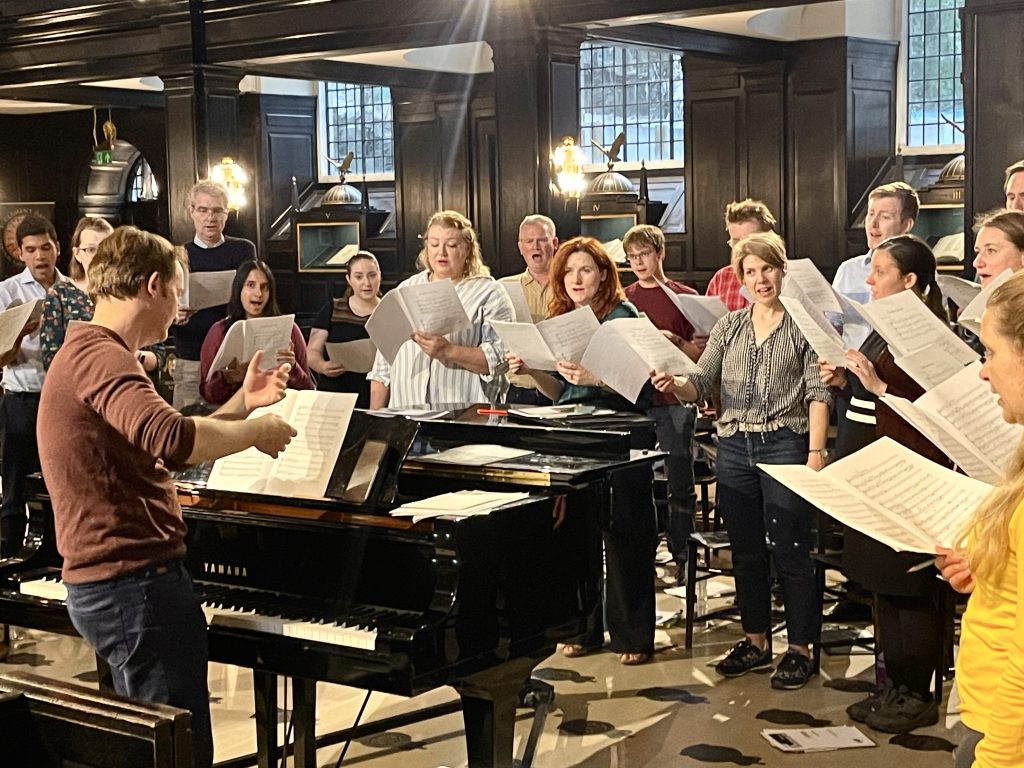
I asked the choir if there were specific moments an audience might listen out for. Soprano Sophie Cass told me ‘The opening is really, really special and sets the tone for something quite unique. We all start quite low in our register, all on the same name note, and then the dynamic changes very quickly. It’s very impactful. So I think the audience will be sitting up and thinking “Oh this is something new and interesting!”’ Rufus Frowde added, ‘The very opening is very spacious and the way it’s set is very grand. The way Stephen Dodgson sets the words is perfect. It scans beautifully and vibrantly!’
The sense of dance and the word setting were universally commented on. Betsy Waalen noted ‘It’s really fun to sing in such a rhythmic way. Very visual, and actually multisensory. And it’s fun to sing very poetic words, as it gives you a lot of cues about what to do with the music.’ Playful word painting is certainly in evidence where Stephen Dodgson’s musical writing absolutely conveys the sense of ‘dancing’, ‘bouncing’, ‘glittering’ and ‘pirouetting’, the latter specifically picked up by several of the singers: alto Rachel Wigmore noted ‘I have never sung the word “pirouetting” in a lifetime of singing choral music!’ Sophie Cass added that the way it’s set really ‘does feel like you’re a ballerina pirouetting’.
Several choir members highlighted the 6/8 section setting ‘you too my lovers, little lark with trembling feathers’. Rachel Wigmore: ‘This bit is wonderful to sing: very light. It feels like you’re dancing. That combined with the syncopation and the “sing you small heart out” is great fun.’ Betsy Waalen also encouraged audience members to listen out for ‘Now with joy I run my race’ which starts with the altos on their own driving forward on a single E before other voice parts join them. She commented, ‘You have to feel it with your body – it’s energetic like a hot summer’s day!’
And all of this set against the contrasting prayerful benedicite refrains which punctuate the work.
Summing up!
Finally I asked the singers to sum the piece up:
This from bass Kieran Morgan: ‘The overall effect is a bit like going on some very high-speed romp round the universe. You’re almost buffeted by it like you’ve been in a supernova – that’s what it feels like singing it. And yet there are all sorts of interesting little bits – some MacMillan-like flourishes at the words “He carries his own up” – there’s an opening out at that point. And the text has been likened to works by Auden and the music has been likened to Britten’s Hymn to St Cecilia, with sort of very skittish, playful qualities and passages where you sometimes get lost in what the other parts are doing that you sometimes forget what you’re meant to be singing yourself! It’s an amazing experience – my first experience of Dodgson. He’s quite a guy!’
And back to Rachel Wigmore: ‘I think the beauty of this piece is that it can really retain your interest – suddenly there are complete changes – suddenly there’s a complete new world of sound: you’re singing about something completely different; you’re in a new time signature; it’s suddenly really syncopated; or in contrast to that it’s suddenly much more melodic and much more homophonic with the choir all moving together. It’s a really surprising piece of music and there’s always something to listen for.’
And final summings-up?
‘It’s funky and it’s poetic, and it’s very evocative of a hot summer’s day.’
‘I think it’s like being dragged around the universe by the Sun in his chariot very fast. I’m hoping we’ll get the excitement of that across without it becoming too much of a white-knuckle ride.’
‘A vibrant, dramatic and playful approach to a contemporary text.’
‘An enigmatic and interesting composer, and one I would like to explore some more.’
‘It’s a very surprising and very engaging piece, and very unusual. It’s a privilege to perform it and I hope that’s how our audience will feel when they hear it as well.’
With thanks to: Rufus Frowde, Sophie Cass, Rachel Wigmore, Betsy Waalen, Kieran Morgan and Carolyn Moores and all of Vivamus.
Vivamus will be performing Canticle of the Sun at 8pm on Friday 20th June at St James’s Piccadilly.
Canticle of the Sun
John Heath-Stubbs (1918–2006)
I am the great Sun. This hour begins
My dancing day – pirouetting in a whirl of white light
In a wide orchestral sky, a red ball bouncing
Across the eternal hills;
For now my Lord is restored: with the rising dew
He carries his own up to his glittering kingdom –
Benedicite, benedicite, benedicite omnia opera.
Look, I am one of the morning stars, shouting for joy!
And not the least honoured among those shining brothers,
O my planetary children – now that my dark daughter,
The prodigal Earth, is made an honest woman of;
Out of her gapped womb, her black and grimy tomb,
Breaks forth the Crowned, victory in his pierced hands –
Benedicite, benedicite, benedicite omnia opera.
You too, my lovers – little lark with trembling feathers,
Sing your small heart out in my streaming rays;
And you, grave eagle, straining your eyes
Against my wound – foretell
These fiery dales and flame-anemoned meadows
Shall be a haunt for shy contemplative spirits –
Benedicite, benedicite, benedicite omnia opera.
And now with joy I run my recurring race;
And though again I shall have to hide my face
With a hand of cloud out of the heart of schism,
Yet the time is sure when I once more shall be
A burning giant in his marriage-chamber,
A bright gold cherub, as I came from my Father’s halls –
Benedicite, benedicite, benedicite omnia opera.
Sonoro recording of Canticle of the Sun:


